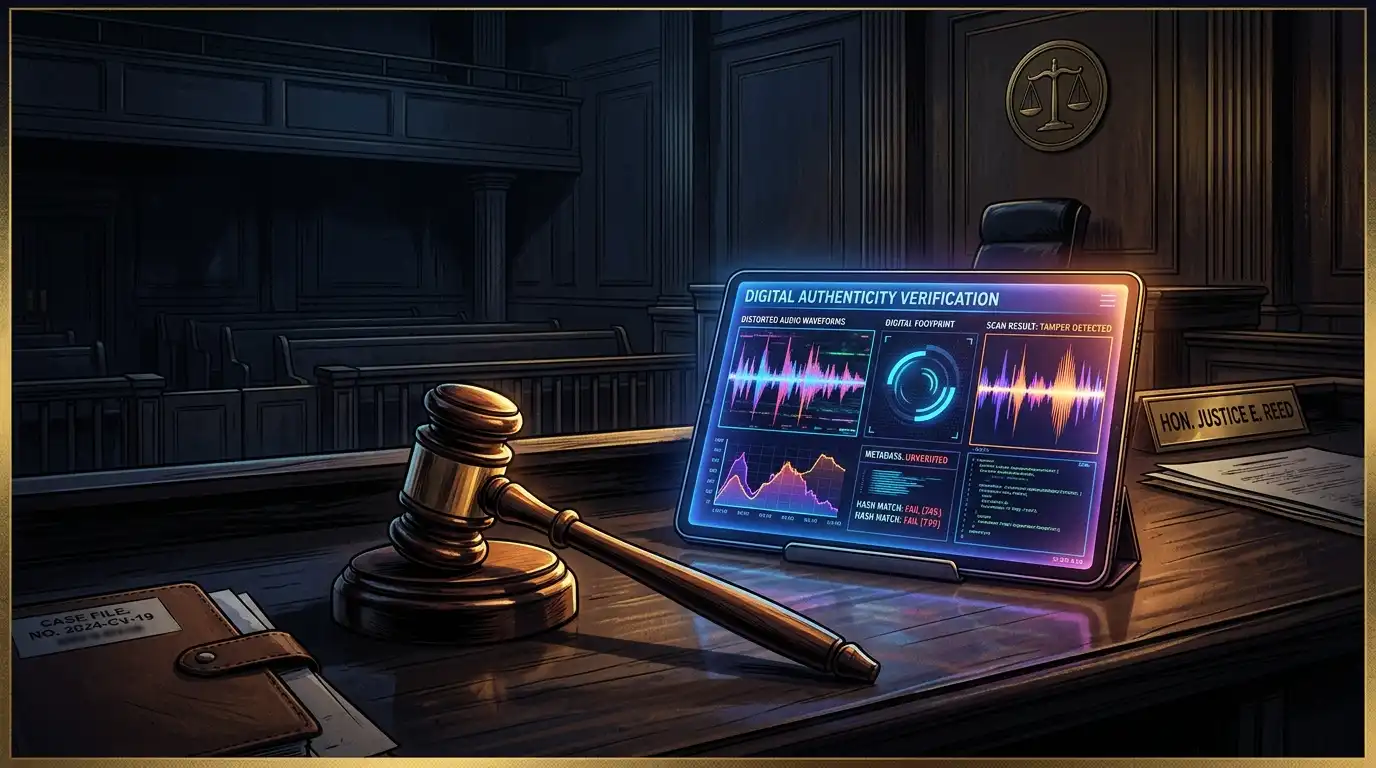
Generative artificial intelligence has crossed a critical threshold, enabling the effortless creation of hyper-realistic video, synthetic voice clones, and falsified digital documents. As synthetic media enters modern litigation, trial judges, forensic examiners, and legal teams are confronting a twin crisis: authenticating genuinely fabricated evidence while combating bad-faith claims that authentic evidence is a “deepfake.”
The Dual Threat: Fabricated Proof and the “Liar’s Dividend”
For decades, electronically stored information (ESI)—such as voicemail recordings, security camera footage, text messages, and corporate emails—carried a strong presumption of reliability when accompanied by standard witness testimony or metadata. Today, consumer-grade AI tools can clone a corporate executive’s voice from a public podcast, create seamless video loops of witnesses, or synthesize believable email threads in minutes.
This technological shift has created a dangerous court phenomenon known as the “liar’s dividend.” Litigators and criminal defendants are increasingly weaponizing the mere possibility of deepfakes to cast doubt on authentic, incriminating evidence. In high-profile cases ranging from commercial fraud to vehicular manslaughter, parties have attempted to dismiss authentic video or audio recordings by simply claiming they were generated by artificial intelligence.
Consequently, judges now face two equal and opposite threats: admitting sophisticated AI fabrications that mislead juries, or excluding authentic evidence because an opposing party raised unverified allegations of algorithmic tampering.
Straining Federal Rule of Evidence 901
At the heart of the evidentiary battle is Federal Rule of Evidence (FRE) 901, which governs the authentication of evidence in U.S. federal courts. Under FRE 901(a), the proponent of an item of evidence need only produce “evidence sufficient to support a finding that the item is what the proponent claims it is.” Historically, under FRE 901(b)(1), this low threshold could be satisfied simply by presenting a “witness with knowledge” who testifies that a video or audio clip is a “fair and accurate portrayal” of what occurred.
In the age of deepfakes, this low prima facie bar is rapidly becoming obsolete:
- Inability of Eyewitnesses to Detect Fakes: Human witnesses are notoriously unreliable at detecting subtle AI synthesis, such as micro-expression glitches, acoustic voice matching, or frame interpolation artifacts.
- Failure of Traditional Metadata: Basic EXIF data and file timestamps—long relied upon during routine discovery—can be easily stripped, edited, or spoofed by consumer software.
- Asymmetry in Verification Costs: Generating a convincing synthetic voice recording costs virtually nothing, while conducting forensic digital analysis to disprove its authenticity can cost tens of thousands of dollars.
Proposed Rule 901(c): The Shift Toward Heightened Authentication
To address this structural vulnerability, legal experts and the Advisory Committee on Evidence Rules have evaluated specific amendments to modernize FRE 901. Chief among these discussions is the proposed **Rule 901(c)** framework, which introduces a structured, two-step burden-shifting procedure specifically for AI-generated or manipulated evidence:
- Initial Showing of Fabrication: A party challenging an item of digital evidence cannot merely assert that it is a deepfake. The opponent must first present specific, objective evidence (such as forensic expert reports or technical anomalies) sufficient to support a finding that the media was created or altered by generative AI.
- Heightened Burden on the Proponent: Once the opponent meets this initial threshold, the burden shifts back to the proponent offering the evidence. Rather than relying on the standard, low prima facie threshold, the proponent must prove to the court that the item is more likely than not authentic (a preponderance of the evidence standard under Rule 104(a)).
Although rule-makers continue to debate whether formal codification or judicial discretion is best suited for evolving technology, courts across the country are already adopting this two-step framework informally during pretrial motions in limine.
Transforming E-Discovery and Digital Forensics Workflows
The deepfake challenge is radically altering early case assessment and electronic discovery. Legal teams can no longer wait until trial preparations to evaluate media authenticity; verification must begin at the point of collection.
1. Cryptographic Hash & C2PA Metadata Standards
Litigators are shifting away from basic file exports toward end-to-end cryptographic chains of custody. Utilizing open protocols like C2PA (Coalition for Content Provenance and Authenticity), media captured on smart devices or bodycams can embed immutable digital signatures, geolocation data, and camera sensor keys at the exact moment of recording.
2. Forensic AI Detection Tools in Discovery
E-discovery platforms are integrating specialized forensic detection algorithms alongside traditional keyword searches. These tools analyze raw file structures for telltale signs of AI manipulation, such as frame rate discrepancies, lighting inconsistencies, biological anomalies (e.g., irregular pulse or blink rates), and spectral audio unnaturalness.
3. Early Pretrial Authenticity Hearings
Under revised Rule 26(f) meet-and-confer protocols, attorneys are proactively establishing ground rules for digital evidence verification. Discovery orders now frequently include specific interrogatories requiring parties to disclose whether any generative AI software was used to edit, enhance, or clean up audio or video files prior to production.
Strategic Takeaways for Litigators and Corporate Counsel

To protect clients from synthetic fraud while preserving the admissibility of legitimate digital assets, law firms and in-house legal departments should implement immediate operational adjustments:
- Secure Evidence at Source: Capture raw, uncompressed digital files immediately upon retention. Always preserve original container files and maintain verified SHA-256 cryptographic hashes from day one.
- Audit Media Enhancements: If your team uses noise-reduction software, AI transcription tools, or video enhancement filters for trial exhibits, document the exact software versions and parameters to defeat defense challenges regarding unauthorized AI fabrication.
- Retain Digital Forensics Experts Early: In high-stakes disputes involving contested recordings, retain forensic experts early in the discovery phase to perform deep-level spectral and frame analysis before dispositive motions are filed.
Conclusion: Preserving Integrity in the AI Era
The proliferation of synthetic media represents one of the most profound challenges to courtroom fact-finding in modern history. As deepfakes become more sophisticated and the “liar’s dividend” threatens genuine proof, the legal profession must respond with rigorous forensic standards, updated procedural rules, and proactive e-discovery strategies. By establishing verified chains of custody and rigorous authentication protocols, litigators can ensure that truth—not algorithmic trickery—remains the foundation of judicial justice.